
Searching Sharkey County Civil Dockets
Gather a few basics before you search. A case number helps most. An approximate filing year plus the type of relief sought narrows things further. Civil matters land in Circuit Court, Justice Court, or Chancery Court, so the court matters. For remote access, Mississippi offers PAMEC, the public subscriber layer of Mississippi Electronic Courts. There is no anonymous live Sharkey County civil search. You must open the right PAMEC account. Only then does the electronic docket and document path open to you.
The PAMEC registration page describes non-attorney access. Its posted terms list a $10 annual account fee plus $0.20 per page returned by a search. A search that returns no match is billed as one page. Field options inside the authenticated interface vary. So do not assume a particular name, date, or case-number box will be there. For an older paper file, a Justice Court file, or an image you cannot reach, contact the clerk. Do not treat a remote gap as a final answer.
- Identify the court type from the notice, summons, prior order, or nature of the civil matter.
- For an eligible Circuit or Chancery file, register for PAMEC and read the current public-user terms.
- Use the exact information on the court paper and verify the court, county, case type, and filing date in any matching result.
- Read the docket sheet in sequence before drawing meaning from a motion, status, default, dismissal, or judgment entry.
- Ask the correct clerk for a certified judgment, decree, or other specific document when an official copy is needed.
Note: Keep the search narrow and the document request precise. That habit avoids unnecessary page charges and reduces the risk of confusing one civil file with another.
Sharkey County Civil Court Channels
Sharkey County runs three local trial-court channels for civil matters. Circuit Court serves as the general civil trial court. It covers matters outside Justice Court's limited jurisdiction or otherwise assigned by law. Justice Court holds lower-level civil records within its statutory authority. Chancery Court keeps equity, domestic-relations, land, estate, guardianship, and youth-court records. Each channel keeps its own docket and record series. Diana Sutton's two elected roles do not merge Circuit and Chancery records. The county has no single civil index.
| Court | Civil docket role | Record contact |
|---|---|---|
| Circuit Court | General civil cases such as contract, tort, and related judgments or appeals. | Circuit Clerk Diana Sutton |
| Justice Court | Limited civil actions within current statutory jurisdiction. | Justice Court Clerk Princess Turner |
| Chancery Court | Equity, domestic relations, land, estates, guardianships, and youth matters. | Chancery Clerk Diana Sutton |
The official Ninth Chancery CourtInfo page shows the electronic docket entries for Sharkey County civil cases in that court.
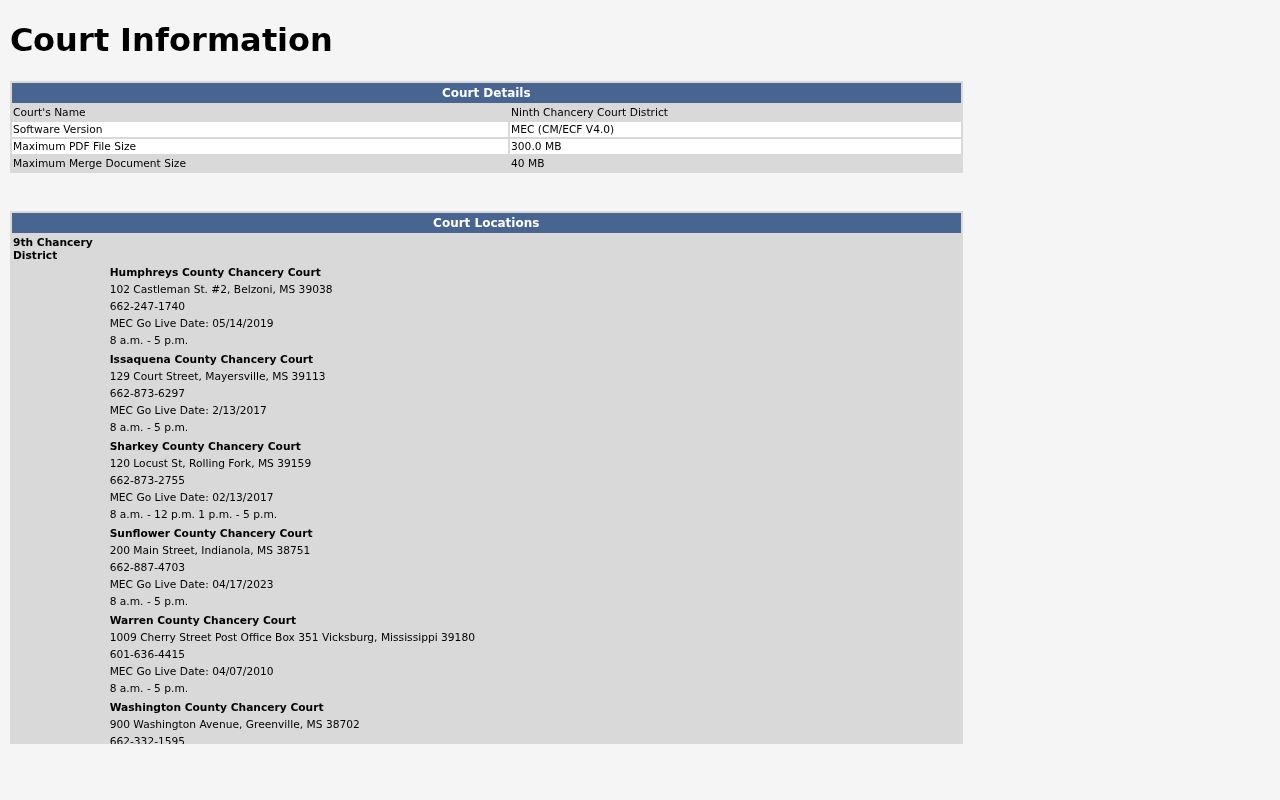
That CourtInfo route separates the Chancery electronic system from the Circuit path. It is a useful first check before requesting any Sharkey County civil record.
Inside a Sharkey County Civil Docket
A civil docket records procedure, not a scorecard. It can show a complaint or petition filed. It can show an answer, attempted service, a motion submitted, or a hearing held. Each entry needs its linked order or document to mean anything. A filing is not a liability finding. A caption names the parties, but it does not name the prevailing side. For the court's actual resolution, look to the final judgment, decree, or other controlling order. That is the reliable record.
| Case number and court | The stable locator and the first jurisdiction check for a Sharkey County civil file. |
|---|---|
| Plaintiff or petitioner | The filing party, not automatically the party who prevailed. |
| Defendant or respondent | The responding party, not proof of liability. |
| Summons and service | Shows the notice process, not the outcome. |
| Motion and order | A motion asks the court to act; the order shows the result. |
| Judgment, decree, or dismissal | The formal resolution or end of a claim, subject to the terms and any appeal. |
A public docket can leave out a protected exhibit or attachment. Read the docket sequence together with the final order before reading meaning into a status like default, dismissal, appeal, or closed.
Sharkey County Civil MEC History
Electronic access has not erased the paper path. Ninth Chancery deployment was reported on February 13, 2017. Sharkey Circuit Court's CourtInfo page reports a September 27, 2021 MEC go-live date. Those are electronic-system milestones, nothing more. They do not prove that every older Sharkey County civil case was scanned or made remotely available. The same holds for estate files, land disputes, and decrees. Older files may still need a clerk-assisted search. Paper, a bound volume, or another local record source may be involved.
The Ninth Circuit ShowIndex endpoint displays the electronic index for Sharkey County cases in that system.
The index route marks the system boundary. It is not a promise of a public anonymous civil-case search or a complete archive of Sharkey County paper records.
Sharkey's 2023 tornado also disrupted courthouse operations and records-preservation work. Ask the clerk whether the item you want is electronic or paper, whether it sits at the listed office or a temporary location, and whether an appointment or equipment limitation affects inspection.
Civil Case Types on the Docket
The court type tells you which Sharkey County civil docket to seek. Circuit civil files can include complaints, answers, discovery-related orders, judgments, garnishment or execution records, notices of appeal, and settlement or dismissal orders. Chancery files may involve domestic relations, land, equity, estate, guardianship, conservatorship, and youth matters. Justice Court handles limited civil actions under its current statutory jurisdiction. A case that moves by appeal can generate related record numbers.
- Circuit contract and tort matters outside Justice Court’s limited jurisdiction.
- Justice Court limited civil claims, subject to the current statutory amount and court rules.
- Chancery domestic-relations matters, including divorce, custody, support, contempt, and modification.
- Chancery land, title, estate, guardianship, and conservatorship proceedings.
- Appeals or post-judgment proceedings that relate to an earlier civil case.
For an estate or property question, keep the court docket separate from a county land, probate, or instrument index. The Chancery Clerk can tell you which one fits. It may be a court file, land record, estate inventory, will, or certified decree.
Sharkey County Civil Amount Check
Check the dollar limit before choosing Justice Court. The 2026 directory shows $3,500 for Justice Court civil jurisdiction. Senate Bill 2696 would raise that threshold to $5,000. Its effective date would be July 1, 2026, if enacted. Whether it became law is not settled here. Confirm the current code before filing. Justice Court Clerk Princess Turner can state the present limit for a Sharkey County civil docket matter. She can also explain the filing requirements and the hearing route. The official 2026 Senate Bill 2696 text is the page shown for this Sharkey County civil docket entry.
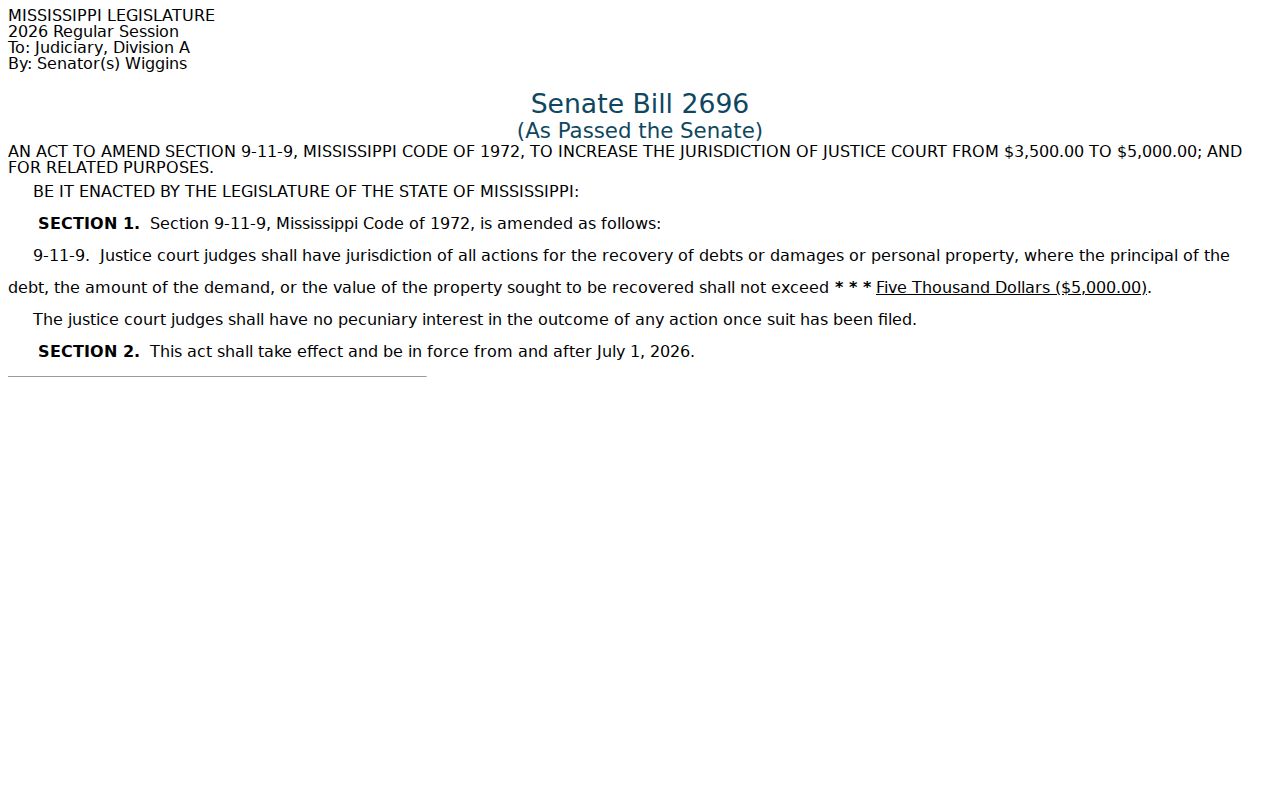
Treat any proposed legislation about the civil jurisdiction amount as a heads-up. It is not settled law here. That caution applies to Sharkey County Justice Court. Numbers travel slowly. A dollar figure quoted in a directory or bill may be years old by the time you read it. Before relying on one for a filing decision, confirm the current amount with the clerk and the code in force today.
Civil Docket Settings and Hearings
A civil setting is a scheduled court event, nothing more. It is not automatically a trial date or a final decision. A docket entry might list a motion hearing. It might also show a status conference, trial setting, continuance, or a later reset. A notice usually names the court, judge, date, time, and appearance instructions. Even so, a newer order can change the plan. Confirm any Sharkey County civil setting with the court that owns the case. Ask whether the matter is still on the active docket.
The Ninth District follows a general calendar rule for Chancery. A monthly term opens the first business day and closes the last, unless the court orders otherwise. Six counties sit in that district. A term entry for a neighboring county is not a Sharkey County hearing. Treat Circuit term calendars the same way. They are planning references, not a case-specific civil setting. The Sharkey County court dates page maps the broader route for checking a setting and any later reset.
- Setting
- A scheduled court event that may be a hearing, conference, or trial-related date.
- Continuance
- An order moving a matter to a later date.
- Final judgment
- An order resolving a case or claim, subject to appeal rights.
- Appeal
- A request for review that can affect how a trial-court judgment is understood.
Sharkey County Civil Judgment Requests
Ask for the narrowest record that answers your question. A certified judgment, decree, dismissal order, or docket sheet is not the same thing as a full case file. When you contact the clerk, give a few details. Name the court and the case number. Also give the document title, any filing or hearing date, your preferred delivery method, and whether you need certification. Sharkey County posts no current copy-fee sheet or order form. PAMEC charges annual and per-page access fees. Those are not the clerk's paper-copy or certification costs. Request a current fee quote before you order anything.
Circuit Clerk
Diana Sutton
P.O. Box 218
Rolling Fork, MS 39159
662-873-2755
Chancery Clerk
Diana Sutton
P.O. Box 218
Rolling Fork, MS 39159
662-873-2755
Justice Court Clerk
Princess Turner
P.O. Box 235
Rolling Fork, MS 39159
662-873-6140
A file you download is not automatically certified. If the Sharkey County civil case is older, ask the clerk where it actually lives: MEC, a paper jacket, a bound volume, or some other archive. Get the cost and delivery method quoted after that check, not before.
Civil Docket Access Rules
Remote access to state civil docket material is possible for registered PAMEC users. The other route is free. It is electronic viewing at a clerk's office during regular business hours, subject to local procedure and equipment. Court records follow a judicial access framework. That is not the same set of rules as the Mississippi Public Records Act. The Public Records Act governs county administrative records instead. That distinction matters when what you want is a court file rather than a county office record.
A docket event may be public. That does not mean every document or attachment attached to it is viewable. Restricted, sealed, expunged, protected-address, and sensitive family or youth material can be limited by law, court rule, or order. A record might show a docket line with no image, a redacted caption, a permission message, or no remote result at all. An empty result can mean something ordinary. It might be an older paper file, a Justice Court file, or a court type outside the system you searched. Ask the clerk whether a public docket entry, a redacted copy, or a certified index can be provided.
Access rules to check:
Miss. Code §§ 25-61-1 and 25-61-5 set the county administrative-record baseline, not an automatic rule for judicial files.
Miss. Code § 9-1-38 and the judiciary openness policy address the separate judicial-records framework.
PAMEC privacy materials explain that access can be limited by law, court rule, or system permission.
Sharkey County Civil Family Limits
Family and civil dockets in Chancery Court call for one more jurisdiction check. The Ninth Chancery District covers Sharkey County plus five neighboring counties. A case can sit where you did not expect. Confirm the county in the caption, the court office, and the case number together. A public docket may show that a motion was filed. It may show a hearing occurred. The sensitive evidence stays out of view, along with financial material, address information, or final terms. Chancery records span domestic relations, estates, land, guardianships, and youth matters. Each category carries its own possible access limits.
Youth-court records are often protected. Recent legislation has kept those rules shifting. Ask Chancery Clerk Diana Sutton what category of record you are seeking. She can tell you whether a court order is required and whether a redacted version can be released. Remember that a court docket is a procedural record. Never use it to infer personal facts. The underlying order and the current access rules keep those private.
Note: When a civil docket entry and a final order appear to point in different directions, the clerk-certified final order controls the court's resolution.